

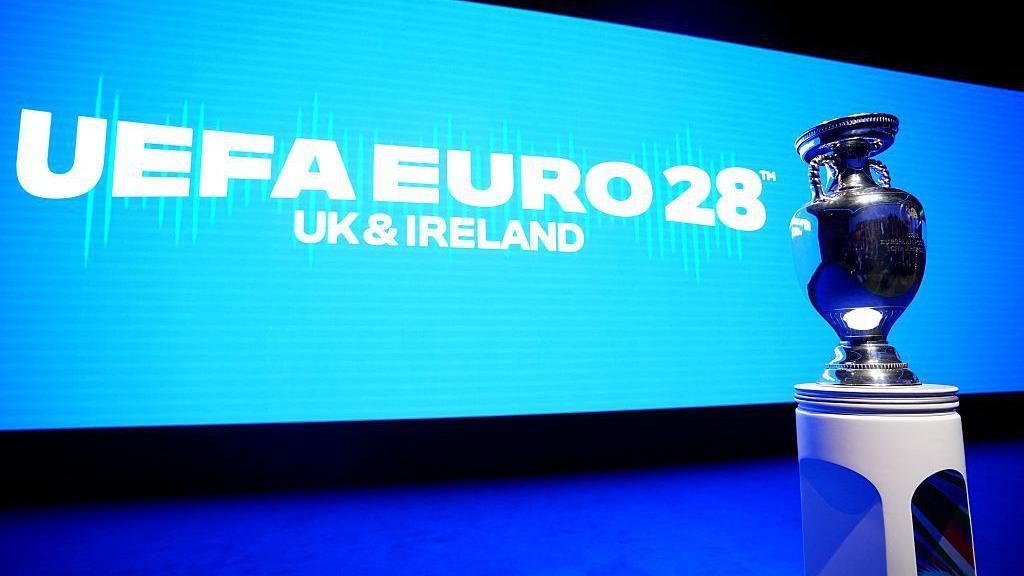
Euro 2028 will be held across nine venues in the UK and the Republic of Ireland.
Uefa plans to largely hold ticket prices for the 2028 European Championships – signifying that supporters will be able to buy five at the cost of one car parking spot at a World Cup stadium in the US during the upcoming tournament.
The Euros hosted across the British Isles and Ireland will feature 40% of tickets reserved for the two lowest-priced "Fans First" categories.
For Euro 2024 in Germany, the cheapest tickets for the initial matches cost 30 euros (£26) and 60 euros (52 pounds). The aim is to keep these below £30 and £60 each for 2028.
Organisers have planned four categories altogether, plus a limited quantity of premium VIP passes which will provide the funding to freeze prices for the average supporter.
Match tickets for the group phase in the more expensive categories at Euro 2024 cost €150 (£130) and 200 euros (174 pounds). Specifics on costs for these categories remain unconfirmed at this stage.
A Sharp Difference in Ticket Cost Strategy
This presents a marked difference to the controversial pricing policy at this summer's World Cup in the United States, Mexico and Canada.
The most affordable matches in the group phase for England initially cost $220 (£167), with the most expensive being 700 dollars (523 pounds).
Fans at the 2028 Euros might be able to attend every one of the three group stage matches during the tournament for the price of one category three World Cup ticket.
Fifa eventually bowed to pressure over its pricing and brought in a highly restricted quantity of 60-dollar (£45) passes for every one of the 104 games.
More Than Admission: High Parking Costs
However, that represents only the beginning in terms of prices at the World Cup.
Reports indicate that the average charge for a parking space at a World Cup game in the US is currently 175 dollars (£133). Parking for group-stage games at MetLife Stadium near New York are priced at $225 (£171).
Ticket Distribution and Fan Access
Organisers have pledged to set aside 10,000 tickets for each country for each group stage fixture.
In contrast, Fifa allocated under 4,000 tickets to each national association at the World Cup, even though most stadiums being bigger.
Controversially, authorities have used dynamic pricing during their sales windows, resulting in costs rising even higher.
Euro 2028 will not have variable pricing and Uefa has promised that roughly half of tickets will be affordable.
Disabled Supporters
This has extended to dispute over the pricing for supporters with disabilities, as well. For the FIFA event fans are required to pay the complete ticket price and they do not receive a complimentary pass for a companion.
At Euro 2028, disabled supporters will be able to purchase the most affordable price bands and can apply for a free pass for a helper.
Resale Markets
The official resale price for UEFA will be the original price, whereas FIFA tickets are resold on a resale platform at markedly higher costs, and FIFA receives a 30% cut on top.
A full list of admission costs and sales dates for Euro 2028 are to be revealed in autumn 2027, with initial sales beginning following the group stage draw in December.
Like the World Cup, ticket prices for the Euros are expected to increase through the knockout rounds.
However, admission for the last four and championship match of the Euros will be vastly different from at the World Cup.
Supporter value tickets for the MetLife Stadium are priced at over three thousand pounds. During the last Euros, the same band of tickets was priced at 95 euros (82.50 pounds).
2028 European Championship Stadiums and Locations
- England: Everton Stadium, Manchester City Stadium, Newcastle's stadium, Tottenham Hotspur Stadium, Aston Villa's home, Wembley Stadium.
- In Scotland: Hampden Park, Glasgow.
- In Wales: The Principality Stadium, Cardiff.
- In Ireland: The Aviva Stadium, in Dublin.


